


Asaba highway landing: Jet’s black box overwritten, says NSIB
August 14, 2026 8:55 pm

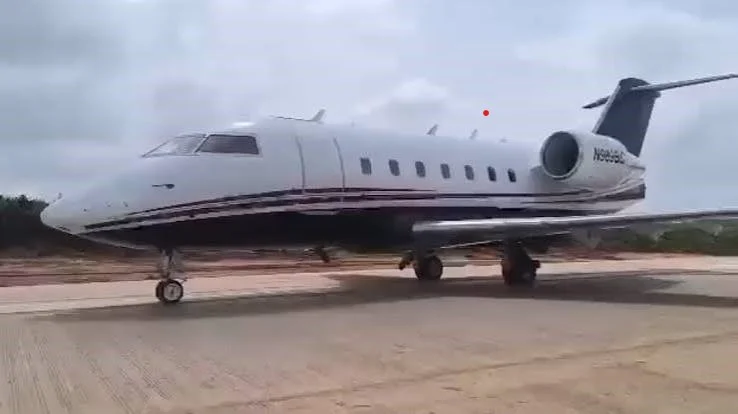
Jet on Asaba construction road. Photo: BusinessDay
The Nigerian Safety Investigation Bureau has revealed that the flight data recorder, commonly referred to as the black box, of the Bombardier Challenger 601 private jet operated by VMO Aero was overwritten before investigators took custody of the aircraft following its landing on a highway in Asaba.
Speaking during a virtual media briefing on Friday, the Director-General of the NSIB, Alex Badeh, revealed this while fielding questions from journalists.
The incident, which occurred on July 10, saw the business jet miss the airport runway and land instead on a concrete road in Ogwashi-Uku, Delta State.
The unusual manoeuvre sparked questions about what led to the landing and the actions of the flight crew afterwards.
According to the NSIB, the aircraft was flown back to Lagos before investigators could get to the scene, effectively overwriting crucial flight data stored in the recorder.
The PUNCH reported that before the authorities could arrive at the location where the aircraft landed, the jet had already taken off and returned to Lagos.
The flight crew were subsequently arrested upon their arrival in Lagos and handed over to the Department of State Services for further investigation.
During the briefing, Badeh disclosed that the pilot flew the aircraft back to Lagos without clearance from Air Traffic Control.
He said the return flight resulted in the overwriting of critical flight data that could have helped investigators reconstruct what happened.
Flight recorders use continuous circular memory systems, meaning that once the storage capacity is reached, new data replaces the oldest information.
In this case, the return flight meant that crucial information relating to the Asaba incident was no longer available in the recorder.
Badeh said, “The rule allows them to have a 26-hour electric recorder but we discover that it only recorded for about two hour of low quality, from when the aircraft took of from Lagos, landed in Asaba and went back they have overwritten everything that happened within that that time. That means thing will be made difficult but we still worked in other ways to ensure that we are able to get the data.
“Although the FTR of the airplane did not work as well, I am not sure what happened but I think it was part of the cleaning, I’m nit sure and I am not going to blame the operators yet, we are still working and we will wait to see whatbtge final report says, all will be in there. So, for me I don’t think the airlines are going out of their way to destroy evidence.
“but they have an LOI from the NCAA, about two Lois now to my knowledge reminding them to preserve data and we are… NSIB have had a workshop with operators, reminding them to preserve data hopefully we may have another work.”
The NSIB boss, however, cautioned against immediately concluding that the operators deliberately destroyed evidence, stressing that investigators were still working to establish exactly what happened.
Badeh also raised concerns about what he described as a troubling culture among some pilots of withholding or altering information because of fears that admitting mistakes could cost them their jobs.
He attributed the problem to a lack of trust between flight crews and safety investigators.
“The crew don’t trust NSIB; they are scared of losing their jobs. It is a major problem we are dealing with. We do not recommend punitive sanctions, and we constantly assure crew members that nobody should be penalised for telling the truth,” he said further.
Beyond the Asaba incident, Badeh also raised concerns over the financial challenges facing the safety investigation agency.
The Bureau is opposing a proposal presented at a House of Representatives public hearing by the Nigerian Airspace Management Agency seeking to reduce the NSIB’s share of the five per cent Ticket Sales Charge from six per cent to four per cent.
The proposal is aimed at increasing NAMA’s allocation.
The Ticket Sales Charge, collected by the Nigerian Civil Aviation Authority, is distributed among several agencies in the aviation sector.
Under the existing arrangement, the NSIB receives six per cent, which Badeh said was already the lowest allocation among the relevant agencies.
He warned that reducing the Bureau’s share would place further pressure on an agency whose responsibilities have expanded significantly.
The NSIB now handles multimodal safety investigations covering aviation, maritime, rail and road transportation.
Badeh said, “We already get the lowest percentage of all the agencies. With this proposed reduction, it’s going to severely affect the NSIB. The Bureau is already grappling with shortfalls in its current allocation; an additional cut is unsustainable.”
The funding challenge comes as the NSIB works to complete its transition from the Ministry of Aviation and Aerospace Development to the Presidency.
According to Badeh, the administrative process is substantially complete, with legislative amendments awaiting review by the Attorney-General of the Federation before consideration by the Federal Executive Council and the National Assembly.
The House of Representatives had previously approved the legislative framework for transferring the Bureau to the Presidency.
Badeh disclosed that the NSIB had not received its full six per cent allocation since around April or May. He, however, said the funding shortfall had not stopped the Bureau from carrying out investigations or expanding its multimodal operations.
He added, “We are working on a more sustainable funded formula for the NSIB. I’m not sure what that’s going to look like yet, but we are talking with the NRS and the Presidency to figure this out.”
He said the aim was to develop a more sustainable funding structure that would allow the Bureau to effectively carry out its responsibilities without being hampered by recurring financial constraints.
The NSIB is also seeking funds expected from other transport agencies.
Badeh said the Bureau had yet to receive applicable funds from the Nigerian Railway Corporation, while the Nigerian Maritime Administration and Safety Agency had disputed its obligation to remit certain charges.
He, however, commended the Federal Airports Authority of Nigeria for its cooperation with the Bureau.
Akinlotan is a journalist at Punch Newspapers with over eight years of experience reporting on politics, social justice, motoring, railways, and aviation. His work focuses on accountability, public interest, and social change, producing stories that inspire reform and amplify underrepresented voices. Akinlotan’s reporting reflects extensive newsroom experience, editorial insight, and a strong commitment to accurate, impact-driven journalism.
All rights reserved. This material, and other digital content on this website, may not be reproduced, published, broadcast, rewritten or redistributed in whole or in part without prior express written permission from PUNCH.
Contact: [email protected]