


Nigeria must export better, not more under China zero-tariff — FG
August 14, 2026 6:46 pm

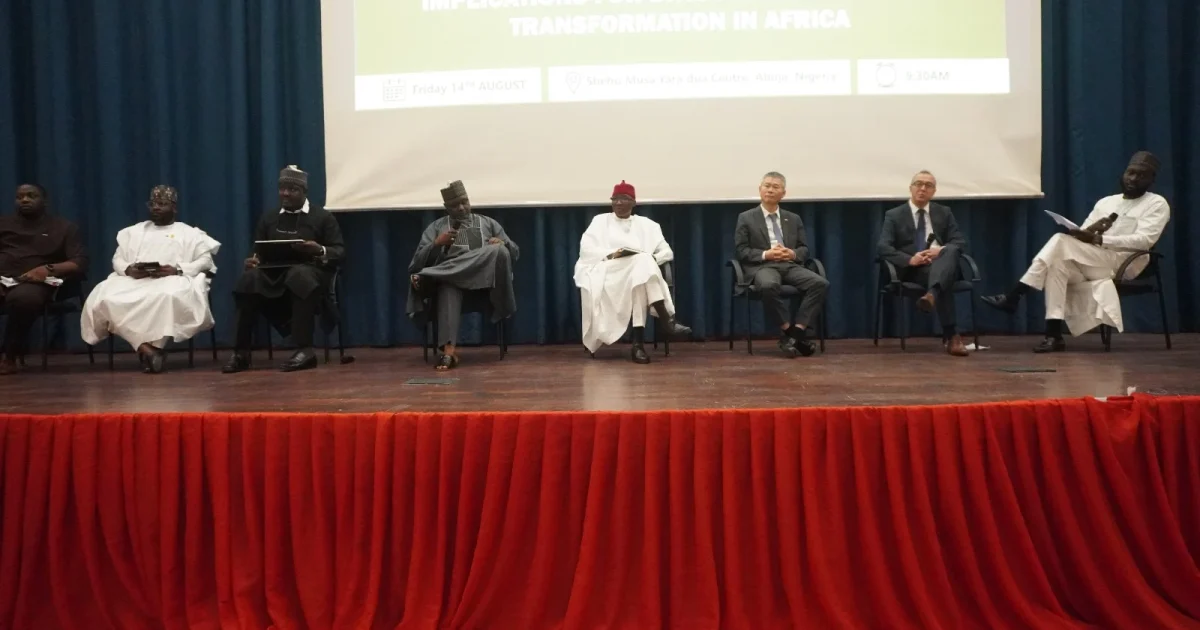
Panel discussion at a Seminar on China’s Zero-Tariff Policy for African Countries held at the Shehu Yar’Adua Centre in Abuja on Friday.
Photo Credit: Centre for China Studies
By Deborah Musa
The Federal Government has said Nigeria must focus on exporting value-added products in agriculture, solid minerals and other sectors rather than merely increasing the volume of raw commodities, following China’s decision to grant zero-tariff access to goods from 53 African countries.
The government made the submission on Friday in Abuja at a seminar on China’s zero-tariff measures and their implications for Africa’s economic structural transformation.
The Minister of State for Agriculture and Food Security, Aliyu Abdullahi, said the policy had created an unprecedented opportunity for Nigeria to diversify its exports beyond crude oil and accelerate value-added production and agro-industrial development.
“The question before us, therefore, is not, can Nigeria export more? The question should be, can Nigeria export better?” the minister said.
He said Nigeria could use the opportunity to export processed cassava derivatives, premium rice, spices, hibiscus, cashew blends, soybean products, fruits and vegetables that meet international quality standards.
“These are the questions that should define our national response,” he said.
Abdullahi cautioned that zero tariffs alone would not guarantee success, stressing that improved market access must be matched with higher agricultural productivity, modern processing industries, efficient logistics, quality assurance, traceability, competitive financing and modern storage infrastructure.
“Zero tariffs alone do not guarantee success. Ladies and gentlemen, while the removal of tariffs creates opportunity, opportunities alone do not create prosperity,” he said.
The minister added that export certification and compliance with sanitary and phytosanitary standards were necessary for Nigerian producers to take full advantage of the Chinese market.
He said the Federal Government was expanding agricultural processing capacity through the Special Agro-Processing Zones Project to support investors in processing agricultural products into high-quality goods for domestic and international markets.
Abdullahi said Nigeria’s abundant natural resources could only translate into competitive advantage through technology transfer, skills development, investment partnerships, research collaboration, modern logistics, digital agribusiness and smart value chains.
Also speaking, the Chinese Ambassador to Nigeria, Yu Dunhai, said China’s zero-tariff policy had produced measurable results for African countries and Nigeria since its implementation on May 1, 2026.
Yu said China-Africa trade reached a historic $207bn in the first half of 2026, while Chinese imports from Africa between May and June stood at $29bn, representing a 24 per cent year-on-year increase.
According to him, the policy had boosted overall African exports to China by roughly six per cent, while Nigeria had recorded particularly strong growth.
“Total bilateral trade reached $18 billion in the first half of the year, up 35 per cent year-on-year, while Chinese imports from Nigeria surged 80 per cent to $2.3 billion, with monthly growth exceeding 40 per cent in both May and June,” he said.
The envoy said Nigeria had benefited from reduced trading costs, increased trade volumes and support for industrial transformation.
He said every 100 tonnes of sesame exported to China saved $11,000 in costs, while Nigeria’s annual export of 7,000 tonnes of cattle bone granules saved nearly $450,000.
Yu added that a single shipment of 23,000 tonnes of Nigerian liquefied propane saved $300,000 in taxes on the first day of the policy.
He urged Nigeria to improve product quality and supply-chain stability, expand local processing and industrial differentiation, integrate trade with long-term investment and strengthen policy outreach to businesses.
“China is ready to provide technical support for standardised production to help Nigerian products earn recognition and market share,” he said.
The ambassador also called for the establishment of an Agreement on Economic Partnership for Shared Development with China, saying it would help turn temporary tariff preferences into institutional guarantees.
He said 38 African countries had signed framework agreements with China to advance early-harvest negotiations.
Representing the Minister of Foreign Affairs, Bianca Odumegwu-Ojukwu, the ministry’s Permanent Secretary, Dunoma Ahmed, said Nigeria should use the policy to move from exporting resources to exporting value.
Ahmed said preferential access to the Chinese market would have limited transformational impact if African economies continued to export predominantly raw materials while importing finished products.
He said Nigeria welcomed investment but increasingly wanted investors to establish manufacturing capacity, develop industrial value chains and create jobs rather than merely extract and export raw materials.
“Our natural resources must become the starting point, not the end point, of economic activity,” Ahmed said.
He added that crude oil should support petrochemical and downstream industries, agricultural commodities should feed agro-processing and manufacturing, while solid minerals should stimulate mineral processing and industrial production.
“In other words, we must transition from exporting resources to exporting value,” he said.
The Permanent Secretary urged Chinese and other international investors to establish factories, processing plants, technology centres and logistics networks in Nigeria, stressing that the country was positioned to serve as a major manufacturing and investment hub for Africa.
Similarly, the Chairman of the House Committee on Nigeria-China Relations, Ja’afaru Yakubu, said the zero-tariff policy could support export diversification, agricultural and resource-based value addition, manufacturing expansion and participation in global value chains.
Yakubu, however, identified infrastructure, logistics, finance, skills, productive technology and regulatory standards as major constraints that Nigeria and other African countries must address.
He appealed to the Chinese Embassy to address visa bottlenecks affecting Nigerian traders, particularly those from Kano and other parts of northern Nigeria, saying easier access would help improve trade between the two countries.
Representing the Minister of Budget and Economic Planning, Abubakar Atiku Bagudu, a Director in the ministry, Samson Ebimaro, said Nigeria must strengthen domestic production capacity and competitiveness to maximise the benefits of China’s zero-tariff policy.

Photo credit: Centre for China Studies
He said the initiative would enhance access for African products to the Chinese market, stimulate export diversification and create new opportunities for Nigerian businesses.
Ebimaro said Nigeria had significant potential in agriculture, agro-processing, solid minerals, manufacturing, leather and creative industries.
“However, the benefits of preferential market access will depend on our ability to strengthen domestic production capacity and competitiveness,” he said.
He urged increased investment in infrastructure, logistics, finance, technology transfer and exporters’ capacity to meet international quality and regulatory standards.
Ebimaro said the initiative aligned with Nigeria’s efforts to promote economic diversification, increase non-oil exports and strengthen value chains.
The Director of the Centre for China Studies, Charles Onunaiju, said the policy should be regarded as a starting point rather than an end in Africa’s pursuit of structural economic transformation.
He urged African countries to address internal constraints and leverage the African Continental Free Trade Area to strengthen regional value chains, harmonise standards and build the productive capacity required to take advantage of the expanded access to the Chinese market.
The seminar was organised by the Centre for China Studies in collaboration with the Chinese Embassy in Nigeria to examine the implications of China’s zero-tariff treatment for African countries and explore practical measures for maximising its benefits.
Deborah Musa is a journalist at Punch Newspapers with five years of experience in journalism, including three years covering the judiciary. She focuses on producing accurate, well-researched reports that provide clarity on legal and justice-related issues. Deborah’s work reflects hands-on newsroom experience and editorial diligence.
All rights reserved. This material, and other digital content on this website, may not be reproduced, published, broadcast, rewritten or redistributed in whole or in part without prior express written permission from PUNCH.
Contact: [email protected]