


‘I’ve never done anything like this in my life’: Marina Abramović on making art with balloons
Drew Zeiba
The artist’s latest swerve sees her creating an alien inflatable landscape for New York’s Balloon Museum
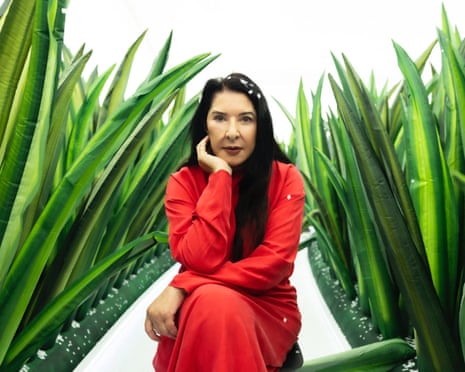
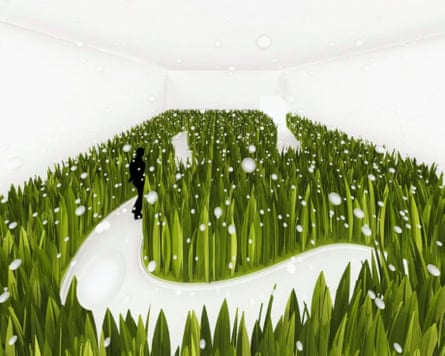
Oversized inflatable blades of grass graze my face as I wind a path through the glowing white gallery space. Little papery squares of snow blow, some sticking to my hair. The path through the room curves so that only what is right in front of me is visible: initially, it seemed like I would reach the far side of the room in mere seconds but still my journey, magically, continues. I am at Snowy/Windy/Spring on Planet Z, the latest installation by the performance artist Marina Abramović. It opened earlier this month at New York’s newly opened Balloon Museum, which bills itself as “the first permanent home for inflatable art”.
“I’ve never done anything like this in my life,” a smiling Abramović said, speaking on Zoom from her Manhattan apartment. “But if you give me an assignment then I’ll try to see what I can do with it.” As she began researching balloon art her first thought was that it was “so kitschy – basically for kids and games”. However, the more she contemplated the balloon, the more she saw its resonance with her own practice. “You put air in it, and at some point the air comes out. Or you pinch it and it disappears. The temporality of this is very close to what I’m doing: performance art.”
Following the success of a 2023 pop-up in New York, the Rome-born Balloon Museum chose the city for its flagship. It rented and revamped the hollowed innards of Jean-Georges’s ill-fated Tin Building, replacing the chichi food hall with an inaugural exhibition titled Daydream, which presents 14 installations from artists including Turner Prize-winner Martin Creed, Balloon Museum mainstay Karina Smigla-Bobinski and the commercial AV installation studio Onionlab.
The installations I liked best were those that destabilized me: Swiss composer and artist Thom Kubli’s Black Hole Horizon showed oversized gramophone-style horns that bellowed resonant sounds and spat out soap bubbles. To experience the work of Boris Acket, a Dutch artist, I lay on a padded floor, hypnotized by a fabric wing that revealed and then obscured my reflection in the mirrored ceiling.
Oh, the mirrors. As is the case at many of these immersive sites, the Balloon Museum is full of them, and it sometimes felt as if the museum was tailoring the installations to meet visitors’ desires to take selfies. (My tour guide insisted that all the mirrors were the artists’ own choices.)
At her institute in Greece, Abramović asks attenders to walk through the forest backward using a hand mirror to see, challenging people to disorient themselves and submit to slowness. But her installation at the Balloon Museum is among those that forgoes reflective surfaces. Before entering Planet Z, I donned wireless noise-canceling headphones through which the artist recited the names of exoplanets in a slow monotone. This personal soundscape added to the sense that I wasn’t only moving through an alien space, but that I was somehow outside of earthly time too. As Abramović said: “I’m giving you the work, but you have to give me time. This is the exchange. If you invest yourself into the work, then you have an experience.”
When we speak she is dressed in red, a color that she’s said she wears to energize her. After many years of performing, the now-79-year-old thinks “it’s time for the public to have a direct experience” of the kind of presentness she’s advocated for throughout her career.
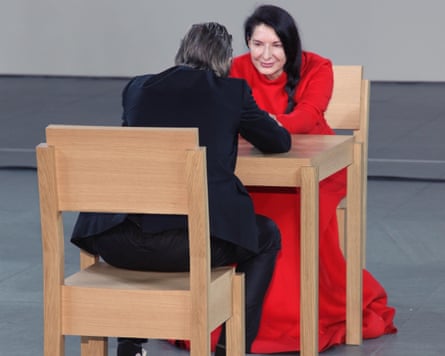
“I really love the completely random propositions people give to me,” Abramović chuckles. In the past couple years, she’s applied her approach to products such as olive oil and a series of tinctures, plus a facial lotion. Since 2002, she’s created arty espresso cups with the coffee purveyor Illy. She’s appeared in a video by Jay-Z inspired by her blockbuster MoMA retrospective The Artist Is Present. The Balloon Museum is just another challenge.
Abramović compares her taking on these projects to Renaissance artists who were commissioned by the clergy and aristocracy. Most of the time, the patrons wanted the depictions of the same conventional pieces: the Madonna and Child or the crucifixion of Christ. “How many of these crucifixions were made for just a few incredible masterpieces?” she asks. “I like it when a team gives you very strict rules, then you have to make a masterpiece out of them. It’s very difficult to do. Sometimes you completely fail, and failure is a very good thing. It’s about courage.”
Roberto Fantauzzi, the Balloon Museum director, hopes that the institution will split the difference between kid-friendly “playgrounds” such as New York’s Museum of Ice Cream and traditional art institutions. “We are completely in the middle, and this is our strength,” he said, as we spoke beside the museum, overlooking the wide-eyed inflatable outdoor sculptures that have become its mascot (you can buy plushy keychain versions in the gift shop).
“I haven’t seen the final result yet,” Abramović told me when I asked her about her response to Planet Z. I knew she wouldn’t say if she felt she’d “failed” or succeeded; when we speak, she recounted a performance she knew in her stomach was a failure “right away”, but refused to say the name or year. It was “famous” and beloved, but the thought of it made her sick. “I don’t care what the public says or the critics say,” she said.
The Balloon Museum is fun, sure. I smiled; at times I felt disarmed by the sense of wonder evoked by some pieces and the contemplative quiet offered by others. I don’t doubt that if I were a child, it might have opened me to possibilities of contemporary art. But I left and the levity I’d experienced dissipated; I was unchanged. The experience had been consumed.
But what did I expect? As Abramović said in a droll tone when I asked her my final questions about the show: “What else do we need to talk about? I mean, it’s just the Balloon Museum.”
-
Snowy/Windy/Spring on Planet Z is at the Balloon Museum, New York
Explore more on these topics