


Nigeria, W’African onion traders sign pact to ease trade
August 14, 2026 12:11 am

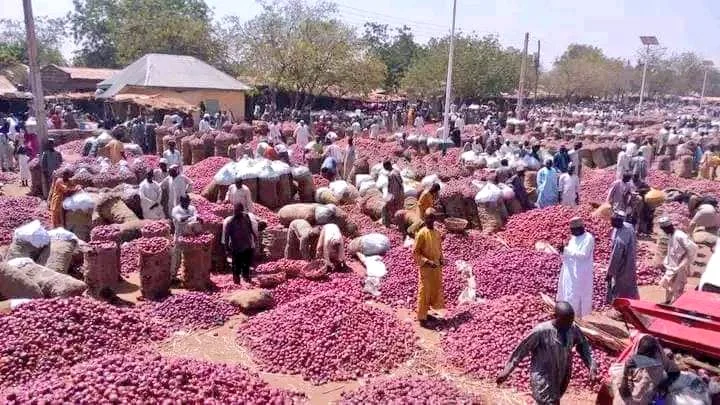
An Onion market in Nigeria. Photo: Google
Stakeholders in Nigeria’s onion industry and their counterparts from across West Africa have signed a Memorandum of Agreement aimed at strengthening cross-border onion trade, improving market access and resolving disputes among traders.
The agreement was signed in Sokoto on Thursday under the auspices of the Regional Observatory of the Onion Sector in West and Central Africa.
The pact comes against the backdrop of recurring disagreements between onion traders and market authorities across West African borders, with traders often facing disputes over market access, movement of produce, trading arrangements and other cross-border commercial practices.
Such disputes have the potential to disrupt the movement of onions, affect farmers and traders, and contribute to price and supply uncertainties in destination markets.
Speaking at the event, the President of the National Onion Producers, Processors and Marketers Association of Nigeria, Alhaji Aliyu Isa, said the agreement was designed to prevent recurring conflicts among onion traders and create a mutually acceptable framework for cross-border transactions.
Isa said the initiative would bring producers, exporters, importers and market operators together to establish clear rules for the movement of onions across the sub-region. He said recent disagreements involving Nigerian onion traders and their counterparts in Ghana and other countries underscored the need for such a framework.
According to him, the agreement would help identify legitimate exporters and importers and establish stronger business linkages among stakeholders. “What we are trying to do here is to understand ourselves better so that the people in Ghana, Niger Republic, Benin Republic or any other country can trade with us under an agreed framework,” Isa said.
He said Nigeria and other African countries had several regional trade frameworks, including the ECOWAS Trade Liberalisation Scheme and the African Continental Free Trade Area, which should be used to facilitate legitimate commerce.
Isa stressed that African countries should not allow avoidable disagreements to undermine trade among people who share historical, cultural and economic ties. “We must learn to love one another. We must not inflict pain on one another,” he said.
He explained that the framework would also provide a mechanism for resolving disputes whenever they arise, rather than allowing individual markets or associations to take unilateral decisions.
On the recent dispute involving Nigerian onion traders and the Kumasi and Kotoku markets in Ghana, Isa said the suspension of onion exports remained in place pending the implementation of the new framework.
“The suspensions remain, but we are waiting to see the framework that we put to de-escalate everything and to bring a kind of formality and formalisation of the things that we are doing,” he said.
He disclosed that discussions had been held with representatives of the Kumasi market, stressing that the market would be required to sign the agreement and provide a list of its legitimate importers.
He added that Nigerian onion exporters would also be identified and their details shared to facilitate transparent transactions. Isa said the arrangement would enable stakeholders to know the actual quantity of onions moving from a particular exporting country to a destination market, thereby providing useful data for governments, financial institutions and development partners.
Earlier, Sokoto State Governor Ahmed Aliyu, represented by the Commissioner for Commerce and Industry, Bashir Abass, described the agreement as an important step towards strengthening regional economic cooperation.
He said Sokoto’s geographical location positioned the state as a natural commercial link between Nigeria and neighbouring countries. “For cross-border trade to realise its full potential, we need greater predictability, transparency and cooperation among the countries and institutions involved,” the governor said.
Aliyu said the onion sector provided livelihoods for farmers, traders, transporters, processors and other participants in the value chain, adding that the agreement could create a more orderly trading environment.
He, however, warned that the success of the agreement would depend on its implementation. “The success of this agreement will not be measured by the signing ceremony alone. Its real value will be seen in its implementation,” he said.
The governor urged stakeholders to respect the agreement and continue dialogue beyond the signing ceremony to identify bottlenecks and address challenges affecting cross-border agricultural trade.
Also speaking, the newly elected President of onion traders in the Benin Republic, Alhaji Bala Aruna, called for unity and compliance with agreements reached by stakeholders. He said producers, merchants, exporters and importers must work together to ensure that the consensus reached at the meeting was respected.
Aruna said the gathering should mark a turning point in efforts to resolve challenges affecting onion commerce across the region, urging participants to ensure that decisions reached were implemented.
The onion trade is an important component of agricultural commerce in West Africa, supporting farmers and creating economic activities for transporters, wholesalers, retailers, processors and exporters.
With onion-producing and consuming communities spread across national borders, traders regularly move the commodity between Nigeria and neighbouring countries.
Stakeholders say establishing clearer rules, identifying legitimate market actors and creating an agreed dispute-resolution mechanism could reduce disruptions and strengthen regional trade. Representatives of onion stakeholders from Niger Republic, Benin Republic, Ghana, Burkina Faso, Côte d’Ivoire and other West African countries attended the event.
All rights reserved. This material, and other digital content on this website, may not be reproduced, published, broadcast, rewritten or redistributed in whole or in part without prior express written permission from PUNCH.
Contact: [email protected]