


Sustain food imports due to insecurity, TUC tells govt
August 12, 2026 12:12 am

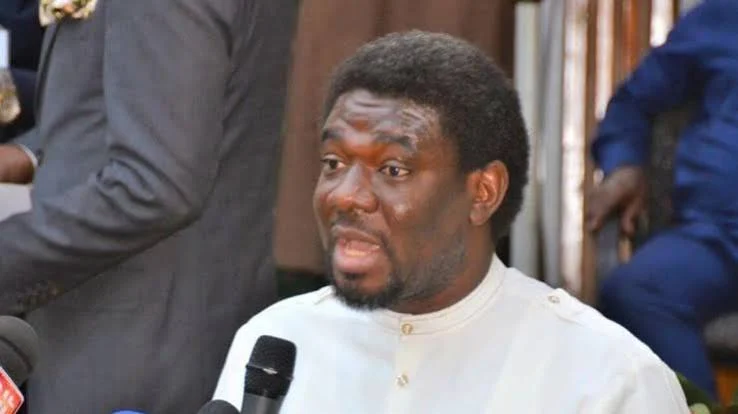
FILE: TUC leader Festus Osifo
The Trade Union Congress of Nigeria has called on the Federal Government to sustain its food importation policy until insecurity is adequately addressed and farmers are able to return to their farms, warning that an abrupt halt could trigger another increase in the prices of staple foods.
The TUC President-General, Festus Osifo, made the call on Tuesday in Abuja while speaking on the economic challenges confronting workers and Nigerians generally.
Osifo said the union remained concerned that although some macroeconomic indicators had stabilised, the improvement had yet to translate into corresponding relief for workers, traders and households struggling with high living costs.
His comments came amid renewed concerns over the cost of living. A recent Reuters report said millions of Nigerians were still struggling with rising food, fuel and other household costs despite improvements in some economic indicators. The report noted that the cost of preparing staple jollof rice had more than doubled since President Bola Tinubu assumed office, while petrol prices had also risen sharply following the removal of the subsidy.
The TUC chief recalled that the union had submitted a 15-point demand to the Federal Government in early 2024, including measures to tackle food insecurity, insecurity and the erosion of workers’ purchasing power.
He said the union supported food imports at the time because insecurity had prevented many farmers from accessing their farms, thereby constraining domestic supply.
Osifo said, “We don’t want a bag of rice to go back again to N100,000. We don’t want a bag of rice to go back again to N120,000. Even where it is today, we still believe it’s still relatively high.
“We still believe it can still come down much more than that. The same thing with the price of tomato, the same thing with the price of yam, because we must feed ourselves before we are able to do anything else.”
He urged the government to address insecurity and improve domestic food production before discontinuing food imports. “Food importations could be stopped only and only if farmers could go back to farms. Only if and only when the supply end has been solved,” he said. “Government must sustain this policy and solve the state of insecurity so that our farmers can go back to farms.”
Osifo also called on the Central Bank of Nigeria to take further measures to strengthen the naira, arguing that the currency remains undervalued. He said the naira had improved from about N1,700-N1,800 to the dollar when the TUC began its advocacy in 2024 to around N1,380-N1,400 currently.
Recent market data showed the naira trading around N1,360 to the dollar in the official market and about N1,425 on the street, with the currency expected to remain relatively stable amid Central Bank interventions.
Osifo, however, said the current rate was still too high and called for a rate of between N900 and N1,000 to the dollar.
“Today, it has stabilised around 1,380 naira to a dollar. But the Trade Union Congress of Nigeria still feels that this is still relatively high. We still believe that our naira is still undervalued,” he said. “If that is done, it is going to reflect in the inflation figures; it’s going to reflect in the cost of goods in the market.”
He argued that workers had not received salary increases that corresponded with the impact of naira devaluation, while the prices of imported goods, food inputs and other essentials had risen significantly.
The TUC’s position comes as organised labour continues to push for another review of workers’ wages less than two years after the N70,000 minimum wage took effect.
The Nigeria Labour Congress and TUC had announced in May that they would commence negotiations for a fresh national minimum wage review in July 2026, citing worsening economic hardship, inflation, insecurity and declining purchasing power.
The NLC subsequently indicated in June that fresh talks could commence at any time, with the current N70,000 minimum wage increasingly regarded by labour as inadequate under prevailing economic conditions.
Osifo criticised the consequential adjustments implemented by governments following the 2024 wage increase, saying they failed to adequately reflect the economic realities confronting workers.
He therefore called for broader salary adjustments, particularly following the Federal Government’s recent decision to increase military personnel’s pay.
“We think it’s the right step in the right direction by the government, so much to increasing the salary of the military officers,” he said. “But we should not just stop with the military. You’ve done it to the military. It’s quite good. But you should extend it to the entire Nigerian workforce.”
On insecurity, the TUC leader renewed the union’s call for the establishment of state police, saying political considerations should not delay a reform he described as necessary for protecting Nigerians.
He argued that concerns that politicians could abuse state police should not be allowed to prevent its establishment. “The question we have asked is that these politicians, what are their numbers?
“When you add all the Nigerian politicians together, they are less than 0.1 per cent of the Nigerian population. So how can we, because of less than 0.1 per cent of our population, allow 99.99 per cent to suffer?” he asked.
He urged the Federal Government and National Assembly to fast-track the constitutional process while deploying modern technology and equipment to strengthen national security.
Osifo also declared the TUC’s support for aviation workers involved in industrial action, accusing some airlines of preventing workers from unionising and failing to remit the five per cent Ticket Sales Charge.
The aviation unions had previously issued airlines a fresh seven-day ultimatum over alleged non-remittance of the five per cent charge. The Air Transport Services Senior Staff Association of Nigeria and the National Union of Air Transport Employees said the earlier ultimatum had expired without satisfactory resolution.
Osifo said the TUC would not accept any attempt to prevent workers from exercising their right to unionise.
“For us, from the ILO Convention to the laws of the Federal Republic of Nigeria, it is our indelible right to unionise,” he said. “We have the right, so no employer can stop an employee from belonging to the union.”
He said the union had been engaging relevant authorities to resolve the aviation dispute but warned that merely persuading workers to suspend the strike without addressing its underlying causes would only lead to another industrial action.
The labour centre also issued a warning to hotels that allegedly prevent their workers from joining trade unions.
Osifo specifically mentioned Abuja Continental Hotel, saying the union had reached the point where it would take stronger action if workers were denied their right to organise.
“A note of warning that the time of talk, talk, talk is almost over,” he said. “If they want their business to continuously thrive, they should allow those workers there to be organised. But if they refuse, we will come after them. We will disrupt their business, and we will ensure that what they don’t want to do in the lawful way, we will force them to get it done.”
On the nation’s refineries, Osifo backed a model in which competent private investors would hold a majority stake while the Federal Government retains a minority interest.
He said the government should not sell the refineries outright but should reduce its equity to a maximum of 49 per cent and allow technically competent private investors to hold 51 per cent.
According to him, the model would reduce political interference and encourage commercially driven decisions. “What we have advocated for is to reduce the government equity in the refineries,” he said.
He said the model should be similar to the Nigeria Liquefied Natural Gas arrangement, where private-sector participation encourages commercial decision-making.
Osifo commended the Department of State Services and its Director-General, Oluwatosin Ajayi, for recent arrests of suspected terrorists and bandits. He urged the security agency to ensure that suspects were prosecuted and convicted where evidence supported the charges.
“When they do well, we commend them. When they don’t do well, we condemn,” Osifo said.
He also commended President Bola Tinubu for approving higher salaries for military personnel, describing the decision as a step in the right direction. However, he urged the President to extend similar improvements to the wider Nigerian workforce.
The TUC leader also commended the Minister of Health, Professor Ali Pate, for intervening in a dispute involving one of the union’s affiliates, saying the minister’s intervention led to the release of some workers and reopening of affected factories.
Osifo said the labour centre would continue to engage the government on policies affecting workers while supporting measures capable of improving the living standards and security of Nigerians.
Deborah Tolu-Kolawole is a journalist at Punch Newspapers with four years of experience covering Nigeria’s vast education sector as well as related areas such as politics, health, security, and labour. She blends rigorous reporting with digital storytelling to bring clarity and insight to complex issues affecting learners, educators, and policymakers. Deborah was a nominee for The Future Awards Africa (TFAA) Prize in Journalism, recognising her impactful reporting and contributions to Nigerian media. Her work reflects strong newsroom experience, editorial judgment, and a commitment to accurate, audience-focused journalism. In addition to her reporting, she is fluent in multiple languages and serves as a contributing member of The Punch editorial board.
All rights reserved. This material, and other digital content on this website, may not be reproduced, published, broadcast, rewritten or redistributed in whole or in part without prior express written permission from PUNCH.
Contact: [email protected]