


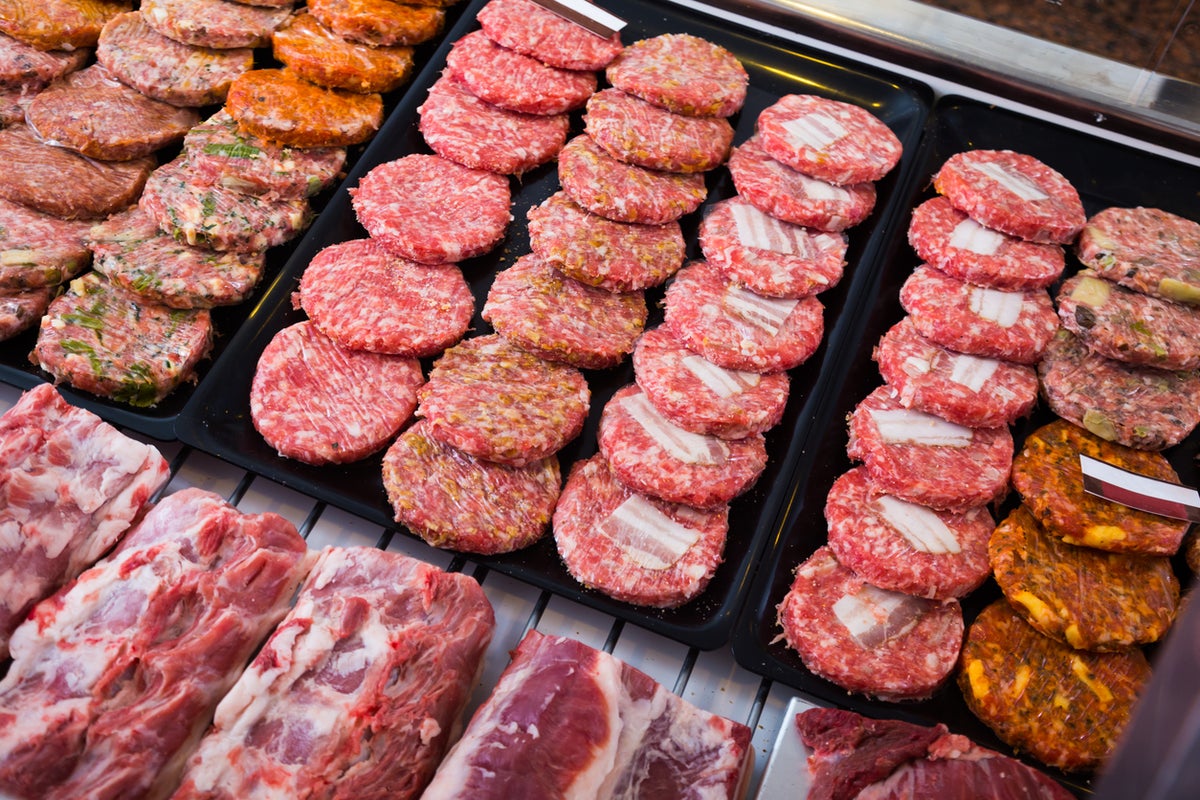
Scientists have engineered lettuce to make a pig protein inside its leaves, which they say could give plant-based burgers the colour and taste of meat without using animal flesh.
Researchers at the Imperial College London inserted a copy of the pig gene into lettuce and tobacco seedlings, and found that the plants not only produced the protein but grew normally, flowered and passed the trait on to the next generation, according to a new study published in the journal Frontiers in Plant Science on Thursday.
The gene was fired into the plants using a gene gun, which shoots microscopic gold particles coated in DNA into the part of the plant cell that carries out photosynthesis.
That chloroplast compartment was chosen because it descends from ancient bacteria, keeps many copies of its own small genome in every cell and is therefore far better than the cell nucleus at churning out large amounts of a protein.
The protein they produce is myoglobin, which stores oxygen in the muscle of vertebrates and is rich in iron, giving meat its red colour and its metallic, savoury taste. It is the reason a beef burger changes from red to brown as it cooks, and its absence is one reason plant-based burgers do not.
“Here we show that plants can be engineered to produce the animal protein myoglobin in their chloroplasts, the energy factories for photosynthesis,” said Alexia Groff, a researcher at Imperial and the study’s lead author.
“This could provide a more sustainable way to produce an important ingredient for plant-based meat products.”
The idea is not to eat the lettuce as a burger but to extract the protein from the leaves, purify it and add it to plant-based products as an ingredient. Because it is identical to the protein in animal muscle, Dr Groff said, it could then improve their colour, flavour and nutritional value.
The approach competes with an established method.
Impossible Foods, the American company whose burgers are sold in Britain, colours its products with leghemoglobin, a similar iron-carrying protein taken from the roots of soya plants and manufactured in genetically modified yeast. Growing the protein in crops rather than in fermentation tanks would avoid the cost and energy of running bioreactors, the researchers argue.
The lettuce and tobacco plants produced about 800mg and 810mg of the protein per kilogram of dried leaf. Beef contains roughly ten times that. The researchers argue that because growing plants uses far less land, water and energy than raising livestock, the yield per hectare could still rival animal farming, though the paper acknowledges that the economic analysis needed to demonstrate that was beyond its scope.
The bigger problem is the iron.
Myoglobin only delivers colour and flavour when it is bound to haem, the iron-containing compound at its centre, and only about 35 per cent of the protein extracted from the tobacco came out with haem attached, against 80 per cent when the same protein is made in bacteria. The authors suspect the plants cannot make haem fast enough to keep up, in part because the same chemical pathway also supplies chlorophyll.
Rodrigo Ledesma-Amaro, professor of engineering biology at Imperial and director of its Bezos Centre for Sustainable Protein, who was not involved in the study, called it an important advance on earlier work in plants and algae.
“Its wider potential will depend on improving haem incorporation so myoglobin can deliver the colour, flavour and cooking properties expected in meat alternatives,” he said.
“Further research must confirm food functionality and safety, field performance, processing requirements, and clear economic and environmental benefits at scale.”
Derek Stewart, professor at the James Hutton Institute in Dundee and co-director of the National Alternative Protein Innovation Centre, said it was encouraging that the protein came out correctly folded and bound to haem, which matters for meat-like colour and flavour, but pointed to limits in the work.
“There are some limitations in the study with holo-myoglobin formation reported as incomplete, haem occupancy was only about 35 per cent, and the study relied heavily on one tobacco line, so robustness and food-functionality remain uncertain,” he said. Tobacco also naturally produces bioactive alkaloids, he added, which would cause problems for extraction and food safety.
The researchers used tobacco because it is the standard laboratory plant for this kind of work, and lettuce because it is edible.
Kyoko Morimoto, chief scientific officer at Kyomei, the Cambridge plant biotechnology company that part-funded the research and employs two of the authors, said modified lettuce might one day be eaten directly as a source of iron, subject to approval. Iron bound in haem is more easily absorbed by the body than the iron in plants.
No one has yet tasted any of it. The paper lists evaluation of colour and flavour in food as work still to be done, and the plants have been grown only in controlled conditions in a laboratory.
The authors note that regulatory frameworks for plant-produced animal proteins carry ethical and religious considerations and have yet to be defined by regulators. A lettuce carrying a pig gene raises questions for halal and kosher consumers, and for vegetarians and vegans, that the study does not address.
The global market for meat alternatives is worth between €6.7bn and €8.1bn a year, or about £5.7bn to £6.9bn, according to figures cited by the researchers, who expect it to grow by between 8 and 12 per cent annually over the next decade.