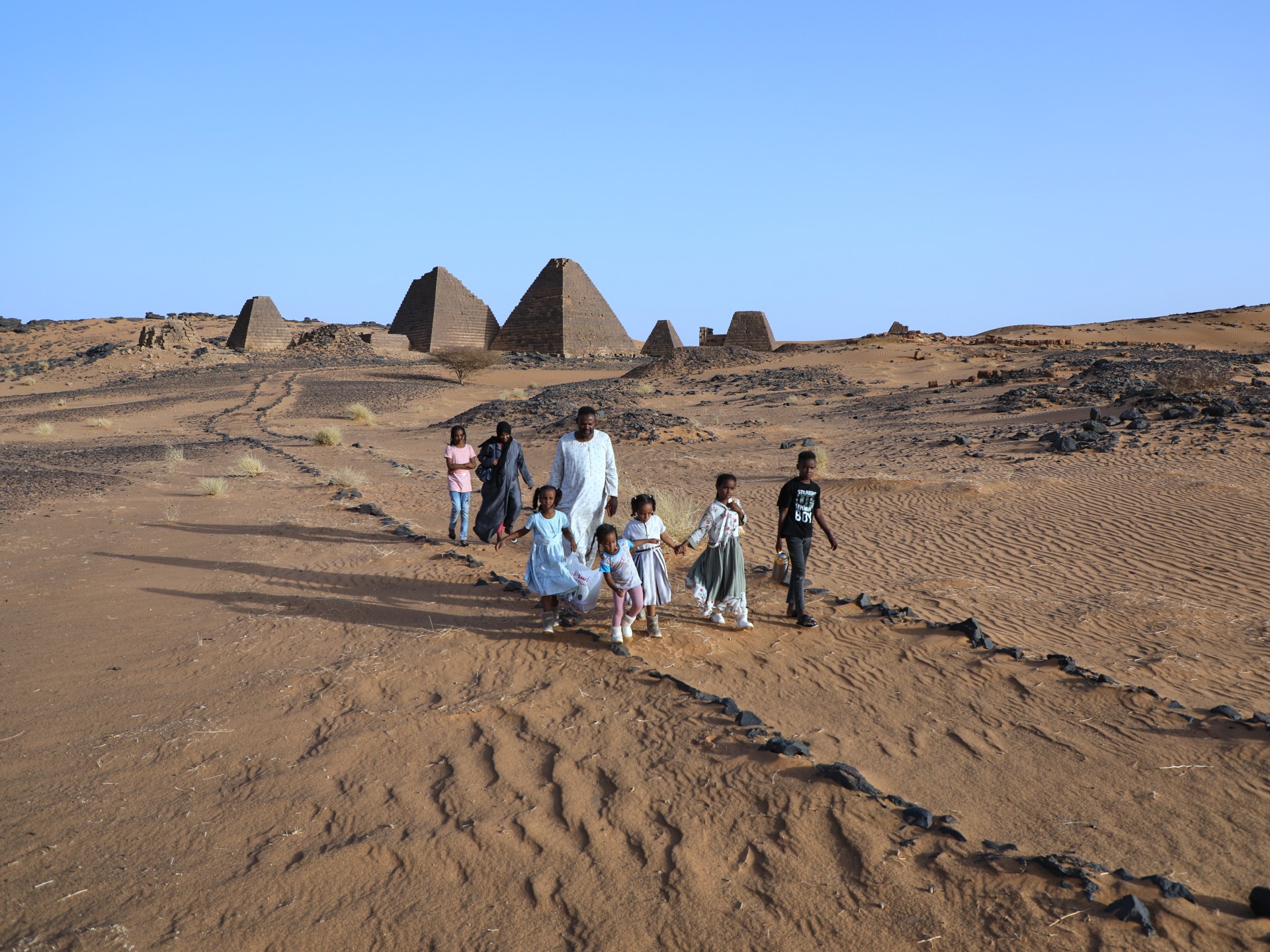
A family visits the Meroe pyramids at the Meroe archaeological site in Bejrawiya, Sudan. [Mohnd Blal/AP Photo]
By AP6 Aug 2026
Sudan’s war is endangering the ancient pyramids of Meroe, a UNESCO World Heritage Site, as fighting and a lack of security have brought all preservation work to a halt and left the fragile structures exposed to the elements.
“The site may face a disaster, and collapses are possible,” archaeologist Mahmoud Suleiman said, warning that the more than three-year conflict has prevented experts from carrying out basic maintenance.
Located about 200km (125 miles) north of Khartoum, Meroe is home to more than 200 narrow, steep-sided pyramids built between 800 BC and 350 AD as tombs for rulers of the Kingdom of Kush.
Guards said windblown sand and encroaching vegetation are accelerating their decay. “The sand has thickened heavily on the pyramids and even inside the temples, and the grass grows thick,” guard Mustafa Ahmed said.
“The pyramids have deteriorated greatly, and stones have begun to fall.”
Antiquities inspector Mohamed Mubarak said salt released from accumulated sand is attacking the “inherently fragile” stones, eroding ancient inscriptions.
Suleiman said climate change, the dispersal of Sudan’s archaeological workforce and the halt of foreign missions have all contributed to “significant deterioration”.
UNESCO has warned that more than 100 cultural sites have been damaged and at least 22 museums looted or destroyed since the war began in April 2023.
Pyramids at Meroe rise from the desert about 200km (125 miles) north of Khartoum in Sudan’s River Nile state. [Mohnd Blal/AP Photo]Archaeologists say salt crystallisation and halted maintenance threaten to erase centuries-old artwork at Meroe, like this carved relief inside a funerary temple. [Mohnd Blal/AP Photo]A guide, left, speaks with a visitor at the Meroe archaeological site. [Mohnd Blal/AP Photo]The Meroe necropolis contains more than 200 pyramids, built as tombs for the rulers of the ancient Kingdom of Kush. [Mohnd Blal/AP Photo]Meroe’s pyramids were constructed from about 800 BC to 350 AD, centuries after the great pyramids of Egypt. [Mohnd Blal/AP Photo]Unlike the broad-based Egyptian pyramids, the pyramids of Meroe are smaller, steeper and more numerous. [Mohnd Blal/AP Photo]The archaeological sites known as the Island of Meroe in semi-desert area near the Nile were listed as a UNESCO World Heritage Site in 2011. [Mohnd Blal/AP Photo]Meroe was once a royal capital of the Kushite Empire, which controlled trade routes along the Nile and deep into Africa. [Mohnd Blal/AP Photo]Many of the pyramids at Meroe were damaged or looted in the 19th century by treasure hunters searching for gold and jewellery. [Mohnd Blal/AP Photo]Today, the pyramids of Meroe stand amid shifting desert sands, offering one of the most striking archaeological landscapes in Sudan. [Mohnd Blal/AP Photo]