


Africa’s old-guard leaders
August 5, 2026 12:05 am

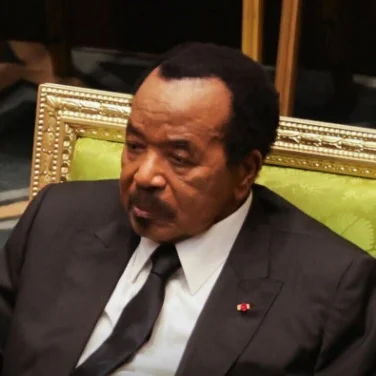
Cameroon’s President Paul Biya | Point De Vue
ONE of the greatest ironies of Africa’s fragile democracy is that many of its oldest politicians still cling to power. Despite advanced age and diminishing capacity, they manipulate weak institutions, bend constitutions and exploit state machinery to prolong their grip on office.
Cameroon is the latest example. Since June 7, 2026, the 93-year-old President Paul Biya has been out of the country on what the presidency described as a brief private stay in Europe, reportedly in a Swiss hospice.
Ironically, this has turned out to be his longest known stay abroad since assuming office in November 1982. Biya is the world’s oldest serving head of state and Africa’s second-longest-serving president.
His prolonged absence has fuelled intense speculation about his health. Yet, amid growing political uncertainty, the ruling party and government officials insist that the state is functioning normally and that the president is governing remotely.
This refrain is all too familiar across Africa. Spokespersons for former Presidents Umaru Yar’Adua and Muhammadu Buhari repeatedly assured Nigerians that their principals’ frequent foreign medical trips posed no problem because they could govern from “anywhere.” Yar’Adua eventually died in office.
Africa’s old-guard leaders should learn from the inglorious end of former Zimbabwean President Robert Mugabe, who ruled the country for 37 years, from 1980 to 2017.
Until his resignation at the age of 93 on November 21, 2017, Mugabe was the world’s oldest leader. He refused to relinquish power until a combination of military pressure, expulsion by his ruling party and impeachment proceedings forced him out. He died in 2019.
Unfortunately, his successor, Emmerson Mnangagwa, 83, has displayed the same sit-tight tendencies.
Recently, he signed into law sweeping constitutional changes extending presidential terms from five to seven years, abolishing direct presidential elections in favour of parliamentary selection, and postponing national elections from 2028 to 2030.
Although Nigerian leaders, past and present, have generally not exhibited a sit-tight mentality, some have nevertheless remained in office at an age when the demands of leadership become increasingly difficult.
Shortly after taking office in 2015, the late Buhari admitted that he wished he had become president much earlier. “Now at 72, there is a limit to what I can do,” he confessed.
Incumbent President Bola Tinubu also travels abroad frequently, particularly to France, for what his aides routinely describe as vacations or working visits. These trips have only fuelled persistent speculation about his age and health.
The conduct of Africa’s ageing rulers has become both insulting and embarrassing to their citizens. Many appropriate national resources for personal comfort while stifling democratic institutions and frustrating leadership renewal. It is little wonder that much of the continent remains underdeveloped.
Among those still holding tightly to power are Ivory Coast’s 84-year-old President Alassane Ouattara, Uganda’s Yoweri Museveni, 81, and Denis Sassou Nguesso of the Republic of the Congo, 82.
For perspective, when Biya came to power, France’s President Emmanuel Macron was barely four years old. Africa’s longest-serving president, Equatorial Guinea’s Teodoro Obiang Nguema Mbasogo, 84, seized power in 1979 when Macron was only two.
Sadly, many African citizens have remained passive. Deep divisions rooted in ethnicity, religion and other primordial loyalties often outweigh commitment to nationhood, making it easier for entrenched rulers to perpetuate themselves in office.
Africans should draw inspiration from countries that successfully challenged authoritarian rule. In Chile, citizens liberated themselves from Augusto Pinochet’s 17-year military dictatorship through determined and sustained civic action.
Faith-based organisations, labour unions and student groups mobilised public resistance, organised nationwide demonstrations and strikes, and ultimately secured a decisive national plebiscite in 1988 that ended military rule.
North Africans delivered a similar message during the Arab Spring in 2011. Mass street protests toppled entrenched authoritarian rulers such as Tunisia’s Zine El Abidine Ben Ali, Egypt’s Hosni Mubarak and Libya’s Muammar Gaddafi.
Likewise, after two decades in power, massive peaceful demonstrations forced Algeria’s veteran President Abdelaziz Bouteflika to resign in April 2019.
Ultimately, the power of the people must always prevail. Civil society organisations, labour groups, religious bodies and the media must rise to the occasion and hold leaders accountable. When citizens unite and declare that they have had enough of poor governance, even the most entrenched governments will be compelled to listen, or better still, be removed.
All rights reserved. This material, and other digital content on this website, may not be reproduced, published, broadcast, rewritten or redistributed in whole or in part without prior express written permission from PUNCH.
Contact: [email protected]