


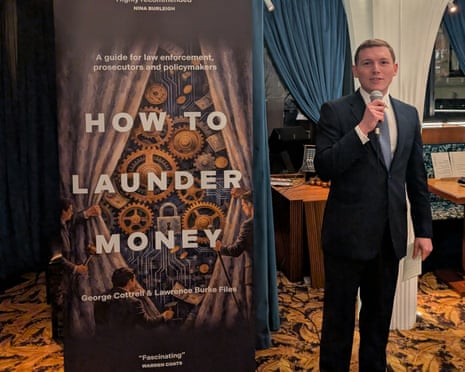
How to Launder Money But Not Like Me, by George Cottrell (as imagined by John Crace)

The Guardian’s parliamentary sketch writer imagines Nigel Farage’s right-hand man’s thinking behind his book, How to Launder Money
Anti-money-laundering laws are supposed to stop the illicit flow of money. So far, they seem to have stopped next to nothing. About 5% of the global economy is illicit and only 0.05% is stopped by AML laws.
Which makes me, George, something of a rarity. The idiot member of the 1% who actually got done for conspiring to launder money. Just think, while 99% of criminals were getting away with it, I had the bright idea of telling an audience of undercover members of the US Inland Revenue Service in Las Vegas how I could clean up their drug money for them. Much to my surprise, they didn’t take me up on my offer. I was arrested on money-laundering charges at Chicago airport. Still, I did a plea bargain and the charges were reduced to wire fraud and I did eight months in prison. So no harm done.
Anyway, that’s all water under the bridge. And in my book How to Launder Money I tell you how you can get away with it by not making the same mistakes as me.
Er, excuse me, co-author Lawrence here. I thought we were supposed to be writing a book to inform the authorities on how to prevent money laundering.
Gosh, sorry Lozza. There seems to have been a misunderstanding. Of course. We’re all definitely against money laundering. I’m all for cleaning up the global economy. It would be terrible if the system got so opaque that it was nigh on impossible to discover how political parties were being funded. Not that it would be illegal. Obvs.
First, we need to think of the nature of money. Money is something you can spend onthings. Not many people realise that. In my time I have spent money on lots of things. Like renting a house near Buckingham Palace that I can make available to Nigel Farage – or Daddy, as I choose to call him – whenever he needs somewhere to stay. I like having lots of money. The key to having a small fortune, as my friend Dicky Tice likes to remind me, is to start with a large one.
We should also be clear that there is a big difference between money laundering and grifting. Grifting is entirely legal. That is what Daddy does when he offers to make personalised Cameo videos for £80. As he often likes to say, every little counts. Of course, the best money is the money you get for doing nothing.
Or in Daddy’s case, a Thai crypto billionaire who coincidentally gifts you £5m just a short while after you have said you need £1m a year for the next five years if you are going to stand for parliament. Any suggestion that Daddy might owe income tax on this should be referred to his accountants. And it’s obviously deeply distressing to hear the £5m was reported to the National Crime Agency (NCA) over money laundering concerns.
Anyway, back to me. Here are several hundred pages of really boring anecdotes of money laundering from Roman times to the present day. Try to look on this book as a cure for insomnia.
One easy way to rinse dirty money is to get someone to paint a fake Van Gogh. No one will notice if another picture of some sunflowers comes on to the market. Then you buy it yourself at an international auction house and donate the painting to a museum. Lo and behold you have suddenly transformed a few thousand quid in dirty money into an asset worth tens of millions. Job done. What could possibly go wrong? Another thing that can work well is bribing people. Though you have to make sure the people you are trying to bribe aren’t undercover agents! If you get my drift.
Perhaps the best way of cleaning money is to become prime minister. That way you don’t have to worry about going through customs with gold ingots or large bundles of high denomination notes. Instead you can just walk on to the private jet with a couple of suitcases and hand them over to Vladimir Putin during a bilateral meeting at which no special advisers are present. With the right person in No 10, the UK could become the world centre of illegal finance. Just think of the boost that could give to our economy.
Of all cryptocurrencies, 99.9% are an outright scam. But don’t let that bother you. Just buy the ones that Daddy recommends as they are obviously legit because they are being run by Kwasi Kwarteng. And don’t think that any monies being donated to Reform UK are dodgy just because they are subject to a Suspicious Activity Report to the NCA.
Make no mistake, no one would be more horrified than me to discover that money from overseas – Montenegro, say – had been used to fund a British political party.
The desire to be loved is a natural human emotion. I long for Daddy’s attention and was thrilled when he allowed me to answer his emails even when I definitely had nothing to do with the day-to-day activities of the Brexit party and Reform. But sometimes it is best to seek anonymity in your financial dealings, regardless of whether your activities are illegal or not. That’s why when I was offering to launder drug money in Vegas I went under the pseudonym Graham Cottrell. No one would ever think of linking that name with my own.
Everything else is quite straightforward. Buy some houses via shell and offshore companies – not that there is anything wrong with these – and leave a trail that is too complicated for anyone to bother to trace. Best of all, you can place bets on the crypto polymarket that you know you are going to lose. That way your illegal money instantly disappears. And the Feds never suspect you of deliberately squandering your assets. This also works well with making legal money disappear. I recently lost £1m on the date of Keir Starmer’s resignation and Donald Trump bombing Iran.
So that’s it. All you need to know to get your criminal activities up and running. I mean, for the authorities to clamp down on money laundering. Thank God my own financial affairs are now so transparent. Happy washing day everyone.
Explore more on these topics