


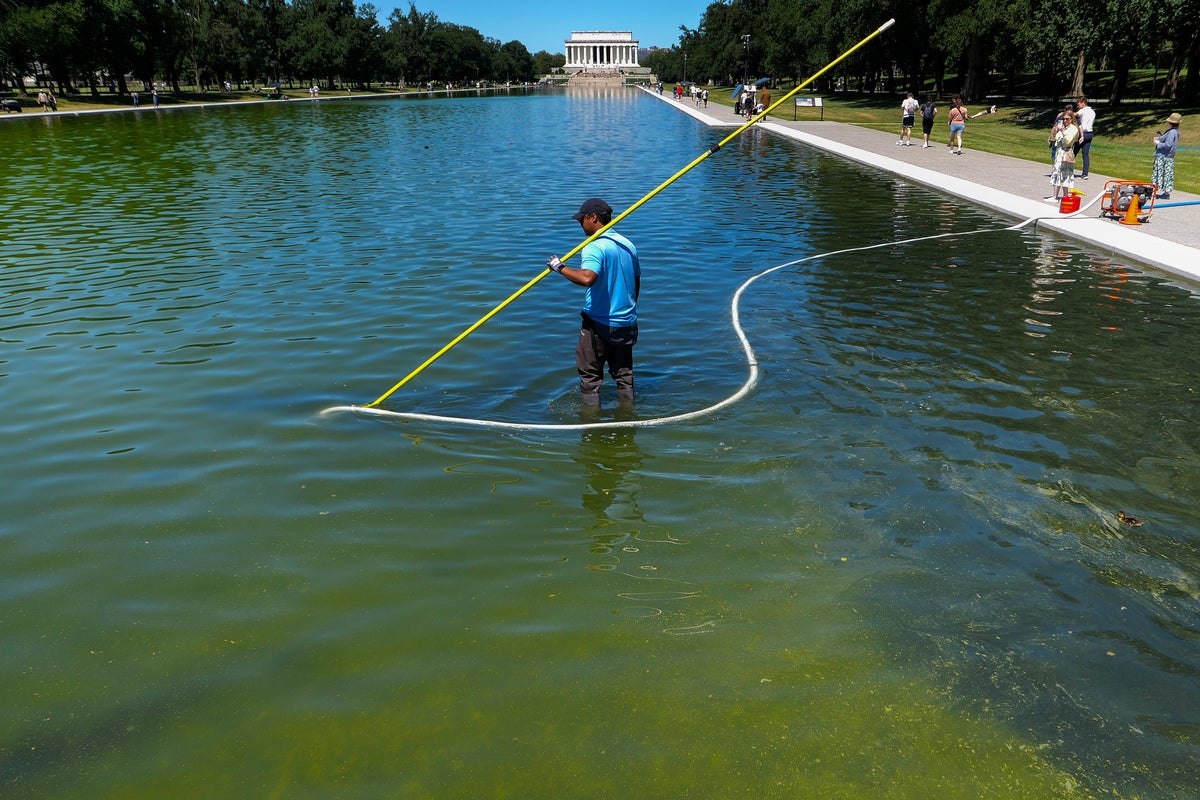
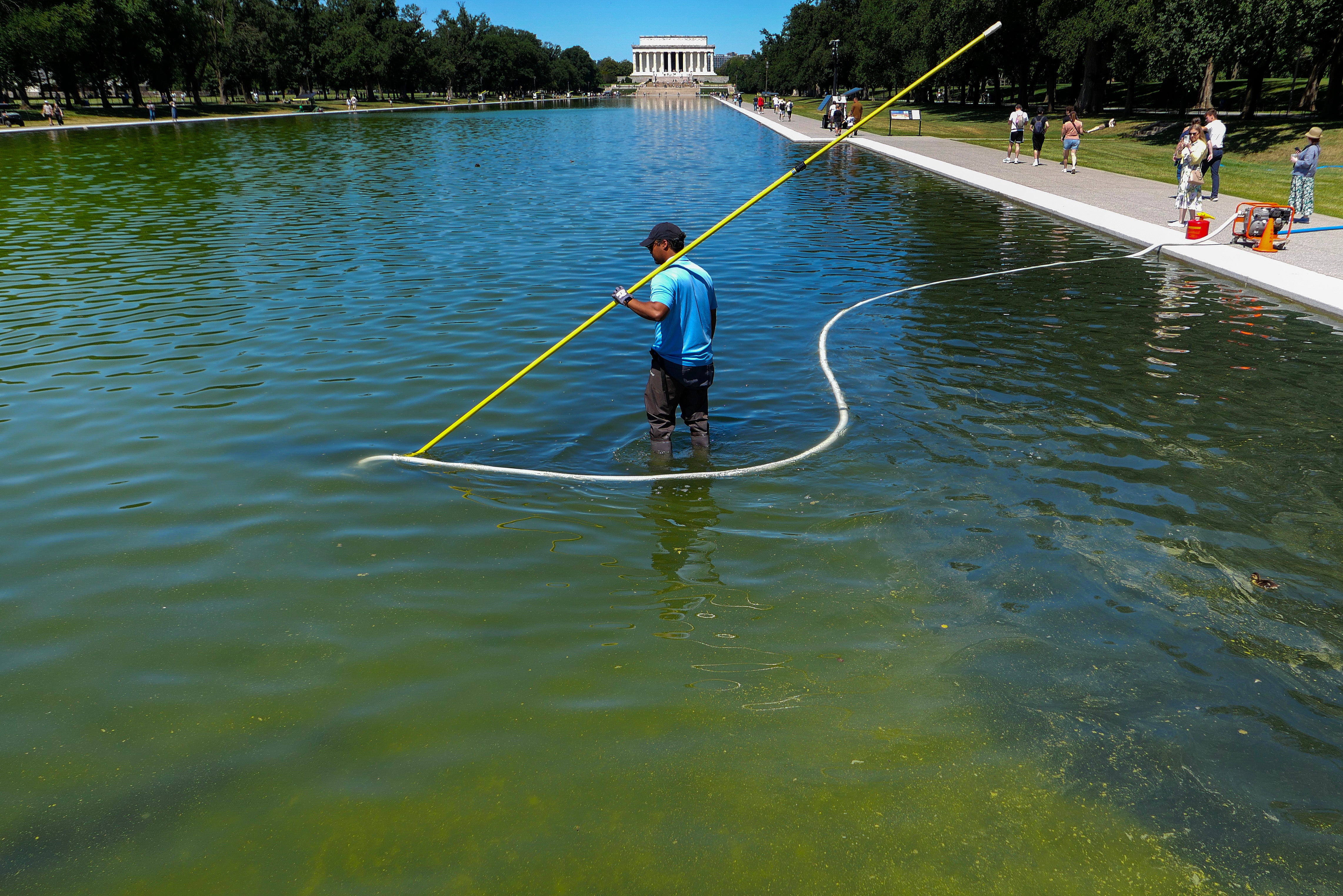
In a bid to tame the algae blooms that clouded the Reflecting Pool almost as soon as its multimillion-dollar renovation was complete, the Trump administration has deployed an array of interventions in recent weeks.
Crews were dispatched to vacuum and scrape away the green growth by hand, nanobubbler filtration systems were installed to pulverize the aquatic organisms and, at one point, workers even resorted to dumping hydrogen peroxide into the water in a bid to restore clarity. President Donald Trump has also suggested the swampy basin — a problem he has blamed on vandals — may ultimately need to be drained.
Now, an outside expert is proposing a gentler approach, a possible solution that lies in working with, rather than against, nature: water fleas.
“Chemical and mechanical solutions are only temporary fixes. When the Reflecting Pool is drained and filled again, there’s a good chance that algae will bloom again,” Eric Palkovacs, a professor of ecology and evolutionary biology at the University of California, Santa Cruz, wrote in The Conversation.
The pool’s size and shallowness means the water heats rapidly in direct sunlight, ideal conditions for algae growth — and a problem that may be compounded by newly applied “American flag blue” paint.
 open image in gallery
“I can tell you there are better solutions that cost far less, last longer and carry less risk of harm to pets and wildlife,” the ecology expert wrote.
Palkovacs, who studies inland bodies of water, wrote that introducing water fleas —a species of zooplankton known as Daphnia — into the roughly 2,000 foot pool, could “can control algae by consuming it before it becomes a pea soup nuisance.”
Beyond their appetite for unsightly green growth, water fleas possess a notable ability to adapt to harsh conditions, making them particularly well suited for algae control in urban ponds contending with heat, pollution, and other stressors, Palkovacs added.
He also urged caution when it comes to draining the Reflecting Pool, warning that doing so would effectively reset the ecosystem — likely at the expense of the very organisms best equipped to keep algae in check.
Daphnia, he wrote, can evolve in response to environmental stressors, developing heat-resistant genotypes and even a tolerance for certain strains of cyanobacteria, commonly known as blue-green algae.
“If a Daphnia population that evolved to tolerate warm temperatures, low oxygen levels or cyanotoxins is removed, the new population likely won’t be ready to handle those local challenges,” the scientist wrote. “This evolutionarily naive population will perform poorly in its new environment, reducing its effectiveness at controlling algal blooms.”
Beyond water fleas, certain rooted aquatic plants can also be used to keep algae to a minimum due to their ability to absorb nutrients, Palkovacs noted.
 open image in gallery
Whether the Trump administration will embrace the scientist’s proposals remains unknown.
For now, the Reflecting Pool has been fenced off for preparations for Fourth of July fireworks. There is also a heightened focus on being on the look out for alleged vandalism, which officials have made a priority to crack down on.
At least six people have been arrested at the historic landmark in connection with alleged vandalism. This week, a grand jury returned a felony indictment against Olympian David Hearn over damage found in the pool. He faces up to 10 years in prison if convicted.
“I didn’t vandalize anything,” Hearn told The Washington Post. “I didn’t destroy or break or peel anything. By the time I realized what was going on, I was being put in handcuffs.”
Internal records obtained by The New York Times indicate Trump officials were aware of extensive problems at the Reflecting Pool even as they were touting their renovation as a complete success. One issue identified by workers was that the algae-control systems were not functioning properly.
On June 28, Trump boasted on Truth Social that “the criminally made algae is gone.” He added: “Right after July 4th, when we will drain the water to treat the damage caused by these ‘animals,’ it will again be in perfect shape.”